Your organisation has an AI strategy. Does it have a workforce plan?
Role-by-role, task-by-task analysis of how AI reshapes your workforce. Grounded in your tech stack, your strategic direction, and the scenarios your board actually needs to see. Initial findings in 1 to 3 days.
The AI roadmap has 35 slides. The workforce plan has four bullet points.
Which roles are actually changing and which just feel at risk?
Which skills do we double down on and which are becoming irrelevant?
What should we automate now vs what still needs human judgement?
What happens if we move faster than competitors?
Your technology team has a roadmap. Your board has expectations. But when it comes to your people - which roles change, which skills to double down on, which to develop, which to let AI handle - most organisations are guessing.
Competitors are acting. Employees are anxious. The window to shape the narrative is narrowing. Transformation is not the same as automation, and both need a plan.
WEF and McKinsey reports analyse at the occupation level using broad averages. GoFIGR extends the International Labour Organisation framework down to your actual roles, your actual tasks, your actual technology context.
From workforce data to strategic clarity
Most workforce planning starts with job titles and ends with averages. Ours start with your AI roadmap and ends with task-level clarity across every role in your organisation. No surveys, no months of preparation, no PII.
Board evidence. Automation ROI. Skills roadmap. In days.
Every deliverable is contextualized to your organization. The assessment reveals risk and opportunity at the same time.
03 · Client results
Where organisations have found clarity
Identifying details anonymised at client request. Results aggregated from engagements delivered in 2025–2026.
TECHNOLOGY· 10,000+ employees
"
We didn’t just need to know which roles AI would affect. We needed to redesign what those roles actually look like in the future. GoFIGR gave us task-level foundation to build a new HR capability, co-creating future state job descriptions with Finance and the business, not just reacting to the technology roadmap
Task-level
Analysis across the entire People function
New capability
HR and Finance partnership launched off the back of findings
Insurance · 10,000+ employees
"
This became the basis for our entire HR strategy - L&D investment, role redesign, workforce planning. We took it to the global board and it's now being used as a consulting tool to identify AI pilots and plan with leaders, not just report to them.
Global board
Presentation built on GoFIGR analysis
Full HR strategy
L&D, role redesign and workforce planning now task-level grounded
FINANCIAL SERVICES - 3,000+ employees
"
The problem wasn't awareness - everyone knew AI was coming. The problem was getting leaders to actually make decisions. We used GoFIGR to put real data in front of them: here’s what's changing in your team, here are your automation opportunities, here's where to invest in skills. It forced the conversation.
Automation ops
Identified and prioritised with leaders, not for them
Skills decisions
Made at team level, not handed down from above
Security & data handling
Built for regulated industries
Healthcare, financial services, and professional services clients run this assessment without PII leaving their control. We designed the workflow so the people questions can be asked safely, before they become people problems.
Enterprise-grade AI processing
Your data is processed using leading enterprise AI infrastructure only. Not used to train models. Your organisational context stays inside the engagement, not the internet
No PII required
The assessment runs on role-level data only. Titles, descriptions, headcount, job families.
NDA by default
Every engagement starts with a mutual NDA. Findings, scenarios, and your organisational context stay confidential. Data deleted within 30 days of completion, or earlier on request.
SOC 2 Type II certified
Independent verification that our security controls meet enterprise standards. Available on request for procurement and compliance teams.
Frequently asked questions
Curious about something else?
Drop us a question and we’ll get back to you!
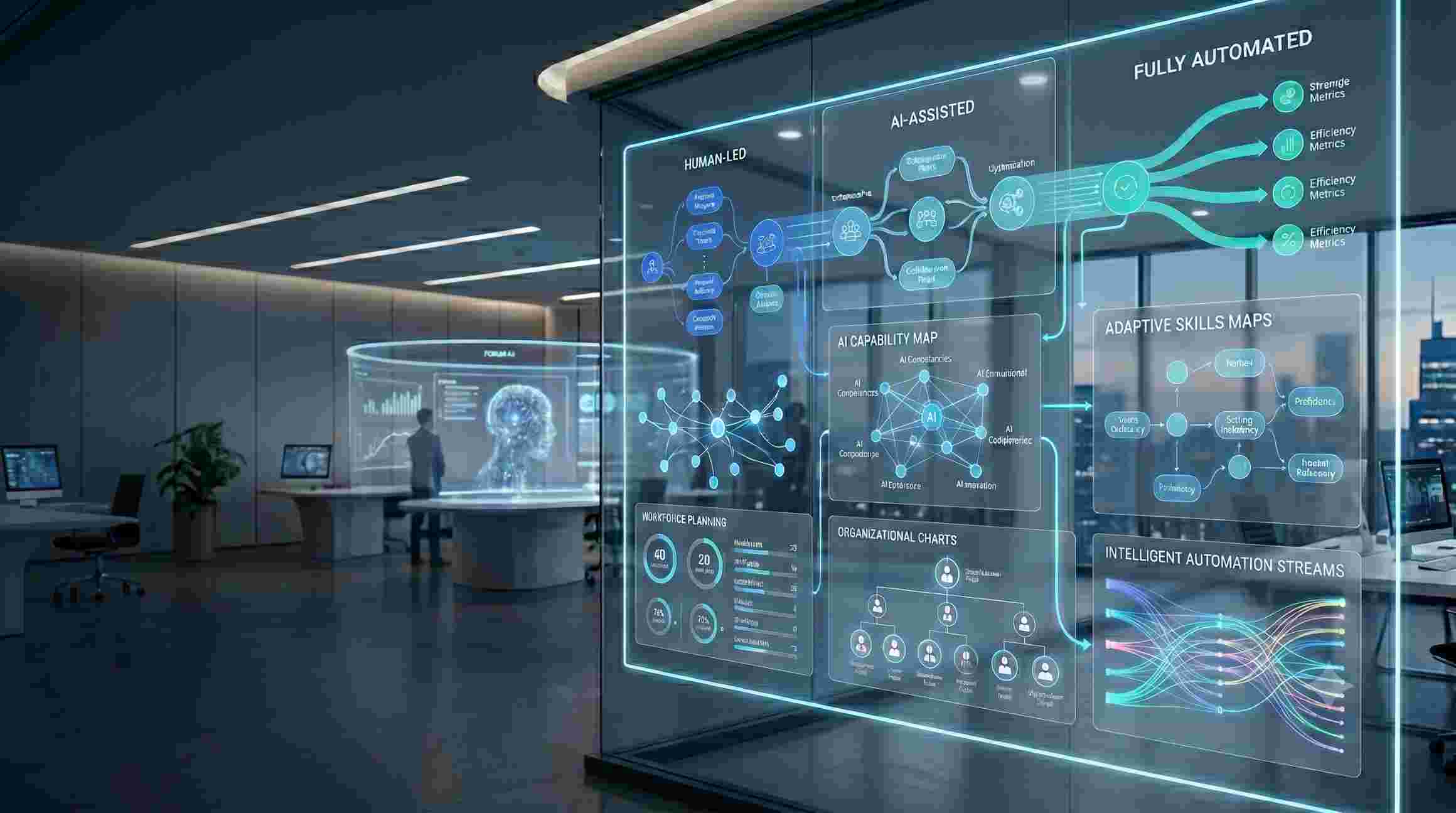
Task-level AI impact analysis assesses how artificial intelligence affects individual work tasks within a role, rather than predicting whether an entire job title will be automated. Every role is broken into its component tasks and each task is individually assessed against current and near-term AI capabilities. This produces a more accurate picture of workforce impact because two employees with identical job titles can have completely different AI exposure depending on how their role is actually structured. GoFIGR extends the International Labour Organisation task framework to classify every task across five future states, from Human Only to Fully Automated, modelled across three adoption scenarios and three time horizons.
McKinsey and WEF reports analyse at occupation level using broad industry averages. GoFIGR analysis is specific to your organisation - your actual roles, your actual tasks, your technology stack, and your AI roadmap. Two organisations with identical job titles can have completely different AI exposure depending on how those roles are structured and what tools they use. Generic reports cannot capture that. GoFIGR extends the International Labour Organisation task framework to your specific context, producing findings that are defensible in a board conversation rather than illustrative of an industry trend. Ream more here.
A non-PII extract from your HRIS or ATS containing role titles, job descriptions, job families, and headcount. No employee names, no personal identifiers, no performance data. You also provide strategic context: your AI roadmap, tech stack, and planned pace of adoption. GoFIGR can work with imperfect or incomplete data. A clean export is helpful but not a prerequisite.
Initial findings are typically delivered within one to three days of receiving your workforce data. From there, we work with you on scenario modelling, skills framework development, and board-ready outputs. No months of preparation, no employee surveys, no lengthy discovery process before work begins.
No. The assessment runs entirely on role-level workforce data. No employee surveys, no focus groups, no individual assessments. Employees are not contacted and do not need to be informed. Many clients deliberately complete the analysis before any internal AI communications, so they can shape the narrative from a position of knowledge rather than react to employee anxiety. Every engagement starts with a mutual NDA. Findings, scenarios, and organisational context stay confidential. Data is deleted within 30 days of completion, or earlier on request.
Automation opportunities are identified through task-level analysis that classifies each task within each role according to its susceptibility to AI automation. Tasks that are routine, rule-based, or involve processing structured information typically have the highest automation potential. The financial value of those opportunities is calculated by mapping task time allocation against role salary data. If a task represents 15 percent of a role's time and that task is fully automatable, the dollar value can be quantified across every employee in that role. Aggregated across an organisation, this produces a systematic view of efficiency gains available through AI adoption, which can be used to prioritise AI investment, build a business case for transformation, and identify where human capacity can be redeployed to higher-value work.
Pricing is scoped to your organisation - number of roles, functions covered, and the level of output and iteration required. Book an executive briefing and we will outline what an engagement for your organisation would look like and what it would cost.
You do. All findings, scenario models, skills frameworks, and raw data produced during the engagement are owned by your organisation. GoFIGR does not retain, repurpose, or use client data or outputs for any purpose beyond the engagement. Every engagement begins with a mutual NDA and data is deleted within 30 days of completion, or earlier on request.
Some recommended posts

Bring evidence to the workforce conversation
Book a conversation with our team to scope the full analysis for your organisation. Initial findings in 1 to 3 days.